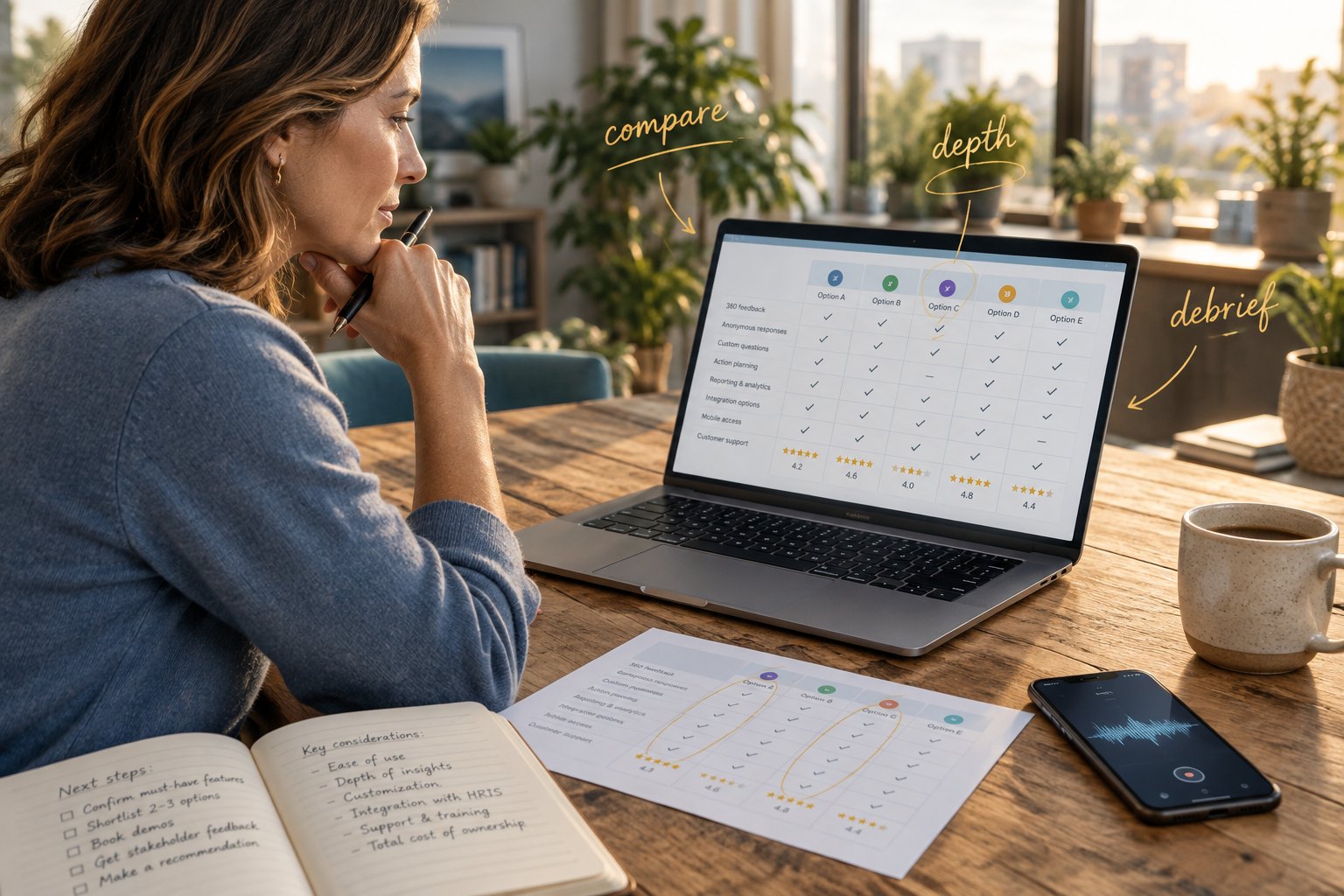
Picking the right 360 feedback tool for your organization is no easy feat in a crowded market, especially when there are different types of tools matched and priced to entirely different audiences. To help you whittle down the options and find the right fit, this guide compares 15 of the best 360 feedback tools based on how they collect and debrief feedback, and how they support the process of turning insights into ongoing development.
We make Your360, so we’ve listed it first. But we’ve also tried to describe every other tool fairly by drawing on our team’s decades of experience building HR and talent products used by millions, including at LinkedIn and Glint. For each tool we reviewed current product pages, published pricing, certification requirements, and G2 scores and user reviews as of October 2026.
What is 360 feedback software?
360 feedback software is a tool that collects and organizes feedback from an employee’s manager, direct reports, and other people they work with. The tool manages feedback requests and brings the responses together in a single location. Platforms may gather feedback through surveys or guided interviews, helping employees understand how others experience their behavior and choose what areas to develop.
Types of 360 feedback
Search for “360 feedback” and the result usually churns out several different approaches under the same name.
- Coach-led interview 360s are the gold standard. An executive coach interviews each feedback provider and asks follow-up questions to probe for detailed, specific examples. The coach then writes a report and debriefs it with the recipient. This hands-on process can cost $10,000 or more per person, so organizations usually reserve it for senior executives. Most coach-led interviews are run by independent executive coaches or boutique firms rather than sold as a product, so they aren’t compared below.
- Developmental 360s help leaders understand how others experience their behavior. Many use rating surveys built around defined competencies. The feedback is confidential to the recipient by default, and a coach debriefs it with them to extract value from the insights. A development plan usually follows the feedback process as a separate step. With the coach's time included, they typically cost $1,000 to $2,000 per person, so are often reserved for directors, senior leaders, and high-potential employees.
- Performance and engagement platforms include 360 feedback within a wider suite. Organizations can run multi-rater surveys alongside performance reviews, compensation, and other talent processes. Results typically go to the recipient’s manager to discuss because a dedicated coaching debrief is rarely included. These platforms usually have a lower headline price because they are sold as per-employee subscriptions, often $10 to $20 per employee per month with a slight annual discount. Their 360 features rarely include interview-based feedback collection or a dedicated debrief.
Your360 brings all the interview and coaching elements of a traditional coach-led 360 into a scalable, affordable platform. Voice AI interviews each feedback provider and the recipient receives a live coaching debrief and personalized development plan. You get the depth of a five-figure coach-led process at a price closer to performance and engagement software.
Best developmental 360 tools
| Tool | Best for | Feedback method | Aggregate insights | Debrief | G2 score (out of 5) |
|---|---|---|---|---|---|
| Your360 AI | Voice-based, interview-depth 360s with a debrief for every leader | Guided, dynamic, and probing voice AI interviews with full debrief and development plan | Anonymized team and org-wide insights | 45-minute AI coach debrief included | 4.9 |
| Korn Ferry 360 Pulse | Enterprise competency-based leadership programs | Multi-rater feedback surveys | Group feedback reports | Certified coach, priced separately | 4.2 |
| Center for Creative Leadership (Benchmarks) | Customizable, research-backed leadership assessments | Multi-rater rating surveys | Group profiles | Certified facilitator, not included in assessment price | 4.5 |
| Leadership Circle | Practitioner-led leadership assessment and development | Standardized assessment questionnaires | Team and organization reports | Certified practitioner, with costs varying by provider | N/A |
| Hogan 360 | Programs already using Hogan personality assessments | Multi-rater leadership surveys | Group and analytics reports | Qualified practitioner, with inclusion varying by provider | 4.3 |
| BetterUp 360 | Organizations already running BetterUp coaching | Multi-rater leadership surveys | Cohort-level aggregate analytics | BetterUp coach within the wider coaching program | 4.5 |
| FranklinCovey | Organizations already using FranklinCovey leadership programs | Self, 180-degree, and 360-degree assessments | Assessment results and skill trends | Expert-led debrief available, with pricing on request | 4.6 |
| Torch | Enterprise leadership coaching at scale | 360 assessment surveys | Organizational intelligence dashboards | Human coach or Spark AI, depending on the program | 4.5 |
1. Your360 AI
Best for: Voice-based, interview-depth 360s with a debrief for every leader
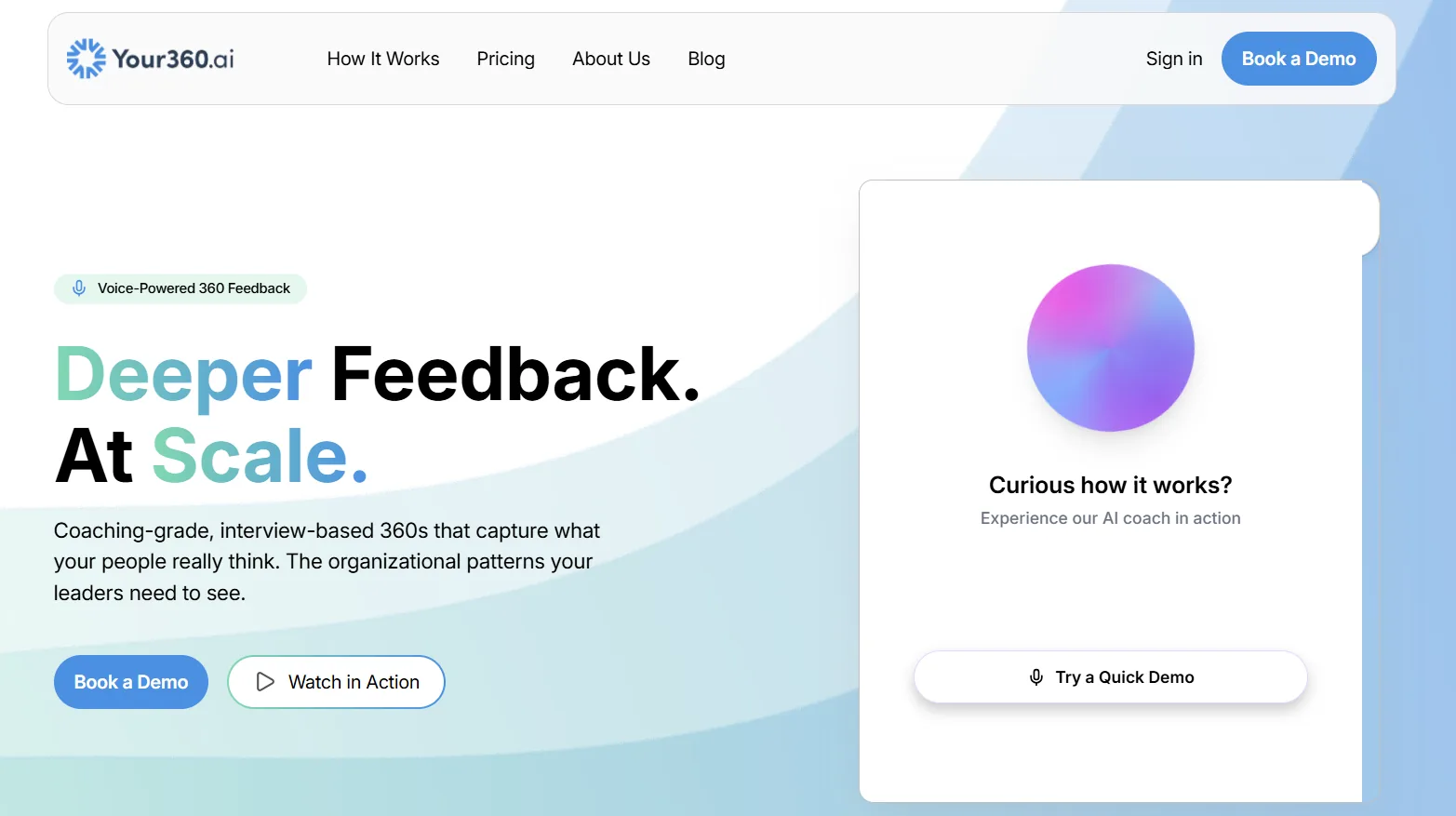
Your360 AI is an interview-based developmental 360 platform that makes coaching-quality feedback available beyond the C-suite. Each recipient begins with a short conversation with Tam, Your360’s AI coach, to set their goals and choose up to 12 feedback providers.
Tam then conducts confidential voice interviews with each provider. The conversation includes follow-up questions that probe for specific examples and capture the context often missing from rating scales or written comments. This gives recipients detailed observations behind each theme rather than an abstract score or statement such as “needs to be more strategic.”
Once the interviews are complete, Your360 synthesizes the feedback into a structured report. Tam delivers the findings through a private 45-minute debrief, helping the recipient decide what deserves their attention and build a personalized development plan. The entire process usually takes two to three weeks, with invitations and reminders handled automatically.
The platform uses qualitative feedback for development and doesn’t produce ratings for stack-ranking employees or informing compensation decisions.
Key features
- Guided voice AI interviews
- Personalized feedback/custom company-wide questions
- Live AI coaching debrief and individual development plan
- Team Effectiveness Report for intact teams, built on the Salas Big Five
- Org Insights showing cohort patterns mapped to your competencies or leadership principles
- Aggregated leadership competency heatmap
- Automated program management, including nudges
- Custom manager visibility and confidentiality settings
- Returning 360s that use findings from the previous cycle as context
Pricing
- Your360’s pricing is a one-time purchase per 360 cycle, not a subscription
- Team plan available for $3,995 for up to 8 recipients, each with up to 12 feedback providers ($299 per additional recipient)
- Enterprise plans offer custom pricing that scales with your organization
- Volume discounts are available
- All Your360 pricing plans are a fraction of the cost of a coach-led interview 360
G2 score
4.9 out of 5
What users say
“Your360 dramatically reduced the time and administrative lift of running our executive review process, while giving everyone a platform to share meaningful feedback. The ability for each person to use AI to review and refine their own feedback for accuracy before submitting was especially powerful.
The process was incredibly well received, and that translated into a high level of trust in both the tool and the results. We’re excited about what we accomplished and even more excited about the potential for future use cases across the organization.”
— Gillian Davis, Chief People Officer · Mission North
2. Korn Ferry 360 Pulse
Best for: Enterprise competency-based leadership programs
Korn Ferry 360 is a multi-rater survey built on the Korn Ferry Leadership Architect competency model. Organizations can use Korn Ferry’s established competencies or configure the assessment around their own framework. The platform supports competency-based and behavior-based approaches, with individual and group reports available for interpreting results across a program.
Korn Ferry also offers certification for coaches and internal practitioners who will interpret the reports and lead feedback sessions. The assessment itself is purchased separately, so organizations need to arrange how each recipient will receive their debrief and development support.
Key features
- Korn Ferry Leadership Architect or organization-specific competencies
- Competency-based and behavior-based survey options
- Individual and group feedback reports
- Practitioner certification for report interpretation and debriefing
Pricing
Custom pricing is available from the vendor on request. Assessments require a separate contract with Korn Ferry’s assessment center.
G2 score
4.2 out of 5
3. Center for Creative Leadership (Benchmarks)
Best for: Customizable, research-backed leadership assessments
The Center for Creative Leadership offers a family of Benchmarks 360 assessments for different leadership levels. Its Benchmarks by Design assessment allows organizations to choose from more than 90 research-based competencies and derailment factors, creating a rating survey around the leadership behaviors they want to develop.
CCL releases each feedback report to a certified or qualified facilitator, who then debriefs the findings with the recipient in a confidential session. Participants also receive access to CCL Compass, where they can explore their results and build an actionable development plan. Group profiles are available for organizations that want to compare patterns across multiple participants.
Key features
- Custom assessments built from more than 90 competencies and derailment factors
- Normative comparisons with other successful managers
- CCL Compass development-planning tool
- Individual feedback reports and group profiles
Pricing
- Benchmarks by Design costs $380 per participant for groups of up to 10
- Volume pricing reduces the participant fee to as little as $305
- Assessment setup fees start at $2,000 for customized designs
- The certified facilitator isn’t included in the assessment price
G2 score
4.5 out of 5
What users say
“With the help of the programs provided by the CCL, I was able to become a better leader.”
— Julian S., a software programmer
4. Leadership Circle
Best for: Practitioner-led leadership assessment and development
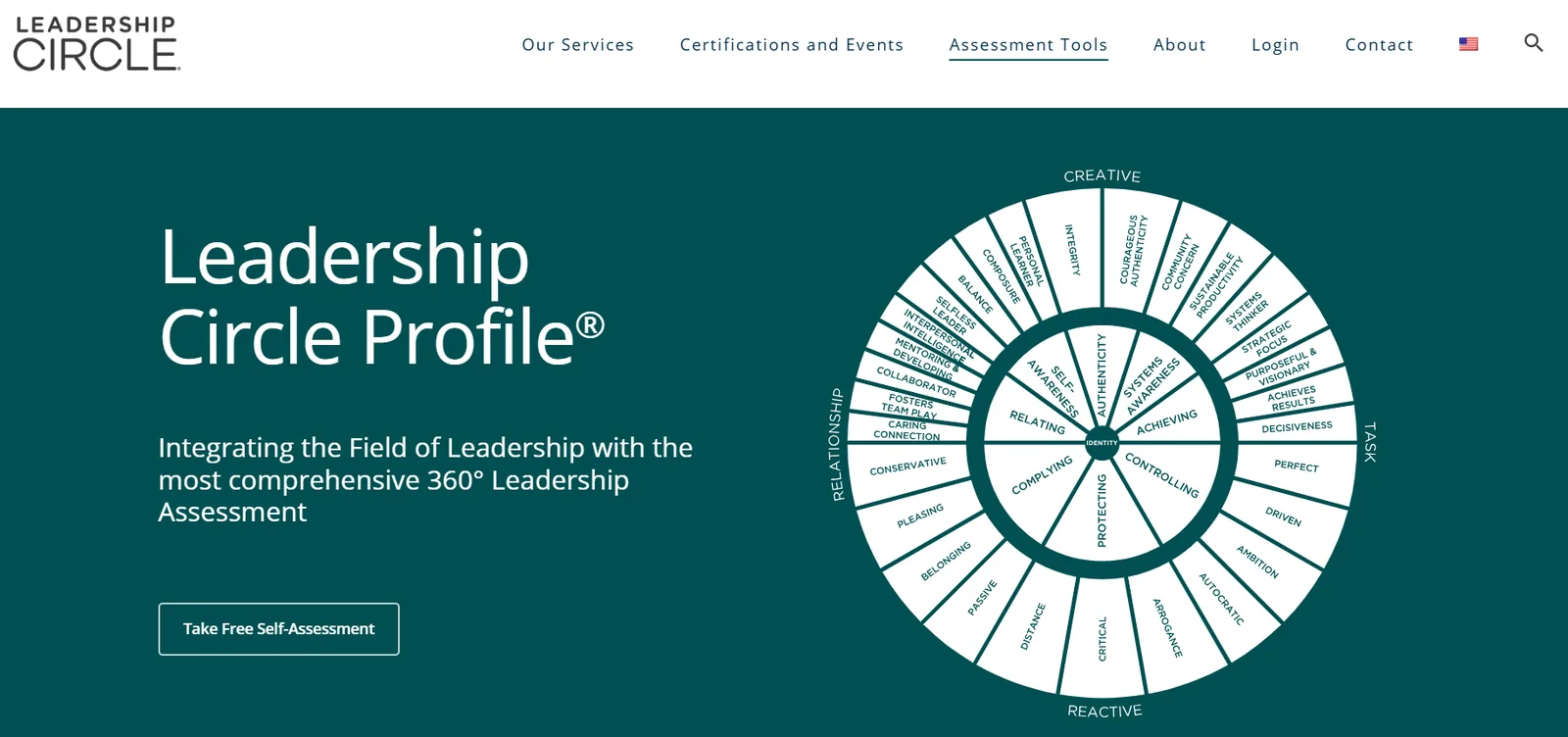
Leadership Circle provides standardized leadership assessments administered and debriefed by certified practitioners. Its flagship Leadership Circle Profile is a rating survey that measures Creative Competencies alongside Reactive Tendencies. These dimensions connect how a leader behaves with the underlying beliefs that may support or limit their impact.
The wider assessment suite extends this approach to teams and whole organizations. Its Collective Leadership Assessment compares current leadership effectiveness with the level employees believe the organization needs.
Key features
- Administration and debriefing by a certified practitioner
- 29 individual leadership dimensions
- Percentile scores compared with a global norm base
- Separate Collective Leadership Assessment for group reporting
Pricing
- Leadership Circle publishes custom pricing, which varies by provider and program. Its practitioner guidance treats the assessment and debrief as separate cost components, so buyers should confirm whether practitioner time is included.
What users say
“In my own direct experience, LCP does much more than tell leaders how they are experienced.
It helps them understand the patterns underneath their leadership. In other words, it sheds light on their inner game, making the invisible visible.”
— Vinay Kumar, executive and leadership coach
5. Hogan 360
Best for: Programs already using Hogan personality assessments
Hogan 360 is a multi-rater leadership survey that compares a participant’s self-evaluation with feedback from the people they work with. Results are also benchmarked against Hogan’s global database by industry and job level. Reports combine visual competency scores with personalized comments, helping leaders identify which areas deserve their attention.
Organizations can use Hogan 360 as a standalone assessment or alongside Hogan’s personality assessments. Peter Berry Consultancy, which developed the tool with Hogan, also offers organization-specific questions and benchmarks. Be aware though, that extensive customization, including competency mapping and group analytics, may cost extra.
Feedback sessions can be handled internally by someone qualified to interpret the assessment or purchased from a Hogan provider.
Key features
- Global managerial benchmarks by industry and job level
- Visual competency scores with personalized rater comments
- Organization-specific questions and benchmarking options
- Individual reports with group reporting available
Pricing
Assessments are purchased through Hogan or an authorized distributor, with debriefing sometimes charged as an additional service, or bundled, depending on the provider.
G2 score
4.3 out of 5
6. BetterUp 360
Best for: Organizations already running BetterUp coaching
BetterUp includes 360 feedback within its wider Whole Person Leadership assessment model. The 360 collects feedback from colleagues on key leadership behaviors, providing insights that feed into the participant’s coaching process.
The assessment works alongside BetterUp coaching and its wider measurement tools. Individual assessment results remain confidential, while organizations receive aggregate analytics showing development and growth across participant cohorts. BetterUp also provides benchmarks for tracking changes over time.
Key features
- Whole Person Leadership assessment model
- Feedback integrated with BetterUp coaching
- Confidential individual assessment results
- Aggregate cohort analytics and benchmarks
Pricing
- Custom pricing is available on request.
G2 score
4.5 out of 5
What users say
“What I loved most was the feeling of having a personalized cheerleader in my corner.”
— IT professional
7. FranklinCovey 360
Best for: Organizations already using FranklinCovey leadership programs
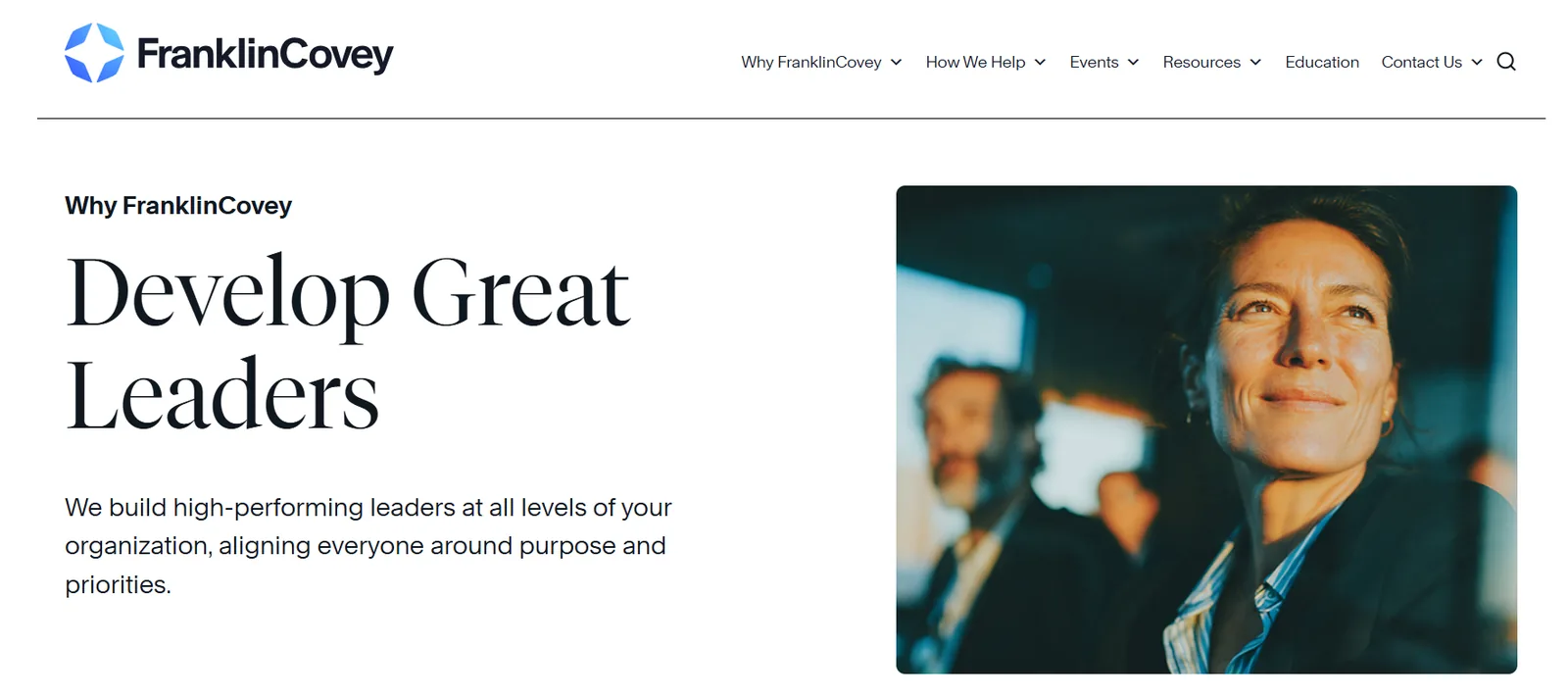
FranklinCovey offers 360 feedback through its Leadership Skills Assessments suite on the Impact Platform. Organizations can choose from self-assessment and multi-rater formats, including 180- and 360-degree feedback.
Once the assessment is complete, organizations can arrange a one-time expert-led debrief. The coach helps the recipient understand their results and choose which areas to develop. FranklinCovey also offers longer-term one-to-one coaching, where assessment findings feed into ongoing behavior change and a personalized plan for sustaining progress.
Key features
- Self, 180-degree, and 360-degree assessment options
- Customized reports with development guidance
- One-time expert-led assessment debrief available
- Longer-term leadership coaching informed by assessment results
Pricing
- Custom pricing is available from the vendor on request.
- Coaching and expert-led assessment debriefs are priced separately.
G2 score
4.6 out of 5
8. Torch
Best for: Enterprise leadership coaching at scale
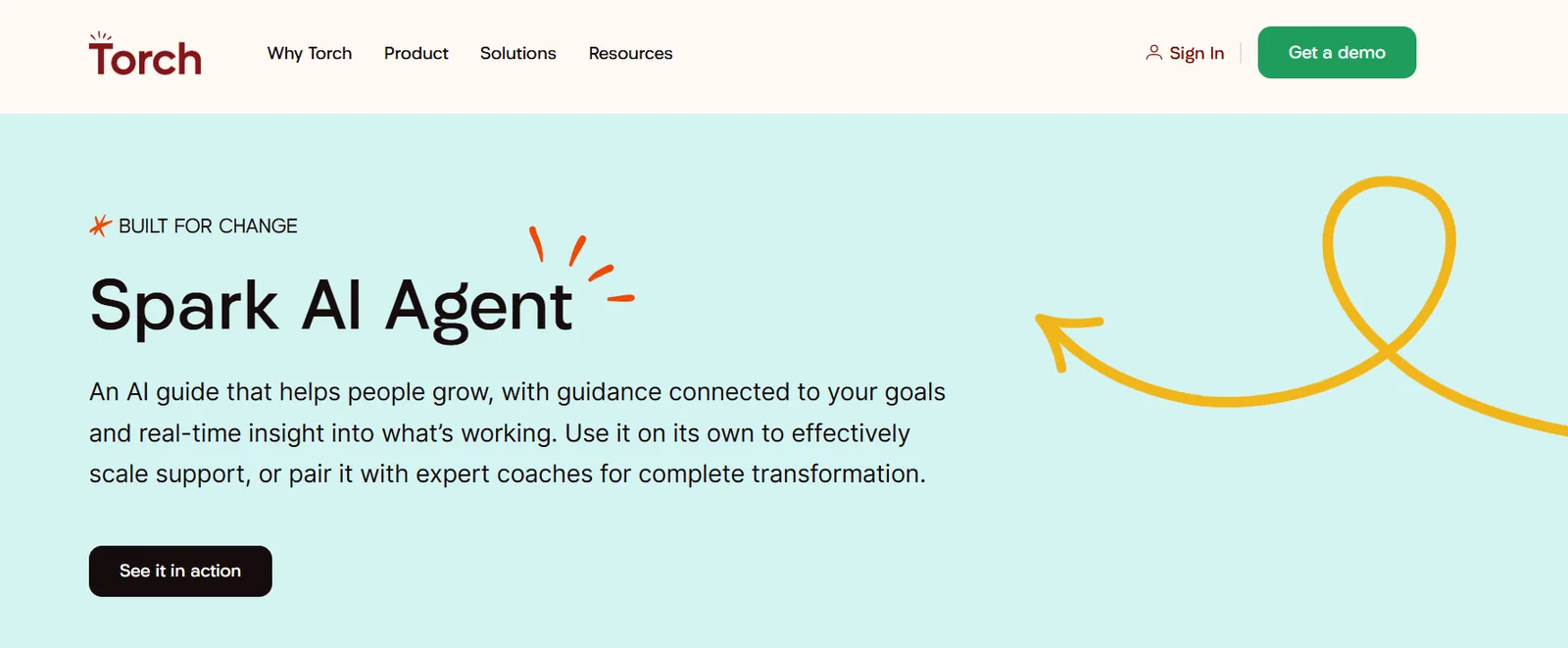
Torch is a human and AI leadership coaching system that uses 360 feedback as one part of a broader development experience. Its core offer combines senior human coaches, ongoing AI guidance and organizational reporting to support leadership change over time.
Organizations can also access Torch’s AI chatbot agent without adding a human coaching engagement. Feedback maps to leadership capacities approved by the organization. Before-and-after 360s can track reported movement over time.
Key features
- Senior ICF-certified coaches
- Standalone Spark coaching agent
- AI guidance and simulations
- Organizational intelligence dashboards
Pricing
- Custom pricing is available from the vendor on request
G2 score
4.5 out of 5
What users say
“Torch is truly a strategic partner - they help you design a program that gives you a return on your investment. Torch has great coaches who take a tailored approach to providing participants exactly what they need to fill in their performance gaps.”
— A consulting professional
Best performance and engagement tools including 360s
| Tool | Best for | Feedback method | Aggregate insights | G2 score (out of 5) |
|---|---|---|---|---|
| Culture Amp | Feedback within a broader people platform | Feedback forms | Manager effectiveness insights | 4.5 |
| Lattice | Integrated performance and talent management | Review forms | Performance analytics | 4.6 |
| 15Five | Manager-led performance and ongoing feedback | Feedback requests and reviews | Outcomes Dashboard | 4.6 |
| Leapsome | Competency-based reviews and employee development | Review questionnaires | Heatmaps and calibration | 4.8 |
| PerformYard Performance Management | Highly configurable performance review processes | Configurable review forms | Aggregate performance reporting | 4.7 |
| Spidergap | Consultants and leadership education providers | 360 feedback questionnaires | Group reports and impact surveys | 4.5 |
| Qualtrics Employee Experience | Enterprise-wide employee listening and development | Multi-rater questionnaires | Workforce skill-gap dashboards | 4.4 |
9. Culture Amp
Best for: Feedback within a broader people platform
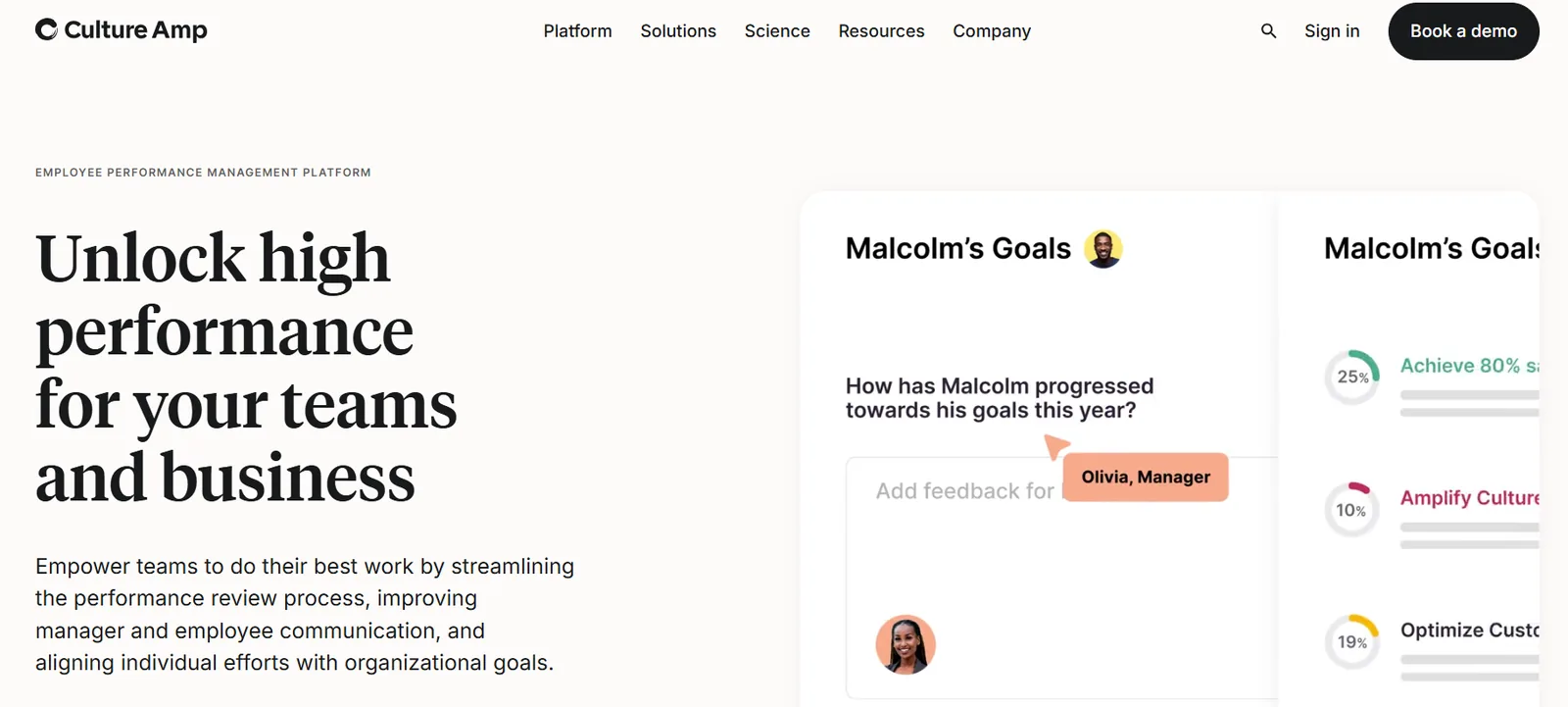
Culture Amp offers 180- and 360-degree feedback as part of its wider performance management suite. Each feedback report highlights specific strengths and development opportunities that help employees decide where to focus.
Teams can use the findings in coaching conversations or connect them with goals and 1:1s. Culture Amp also collates feedback from across the year which feeds into performance reviews.
Key features
- Feedback question templates
- Employee self-reflections
- Strengths and development reporting
- Centralized real time feedback cycle management
Pricing
- Custom pricing is available from the vendor on request
G2 score
4.5 out of 5
What users say
“Culture Amp allows us to have multiple key aspects of our people strategy in one place; engagement surveys, 1:1s, performance reviews, career paths and personal development plans are all there.”
— Amber D., a senior people partner
10. Lattice
Best for: Integrated performance and talent management
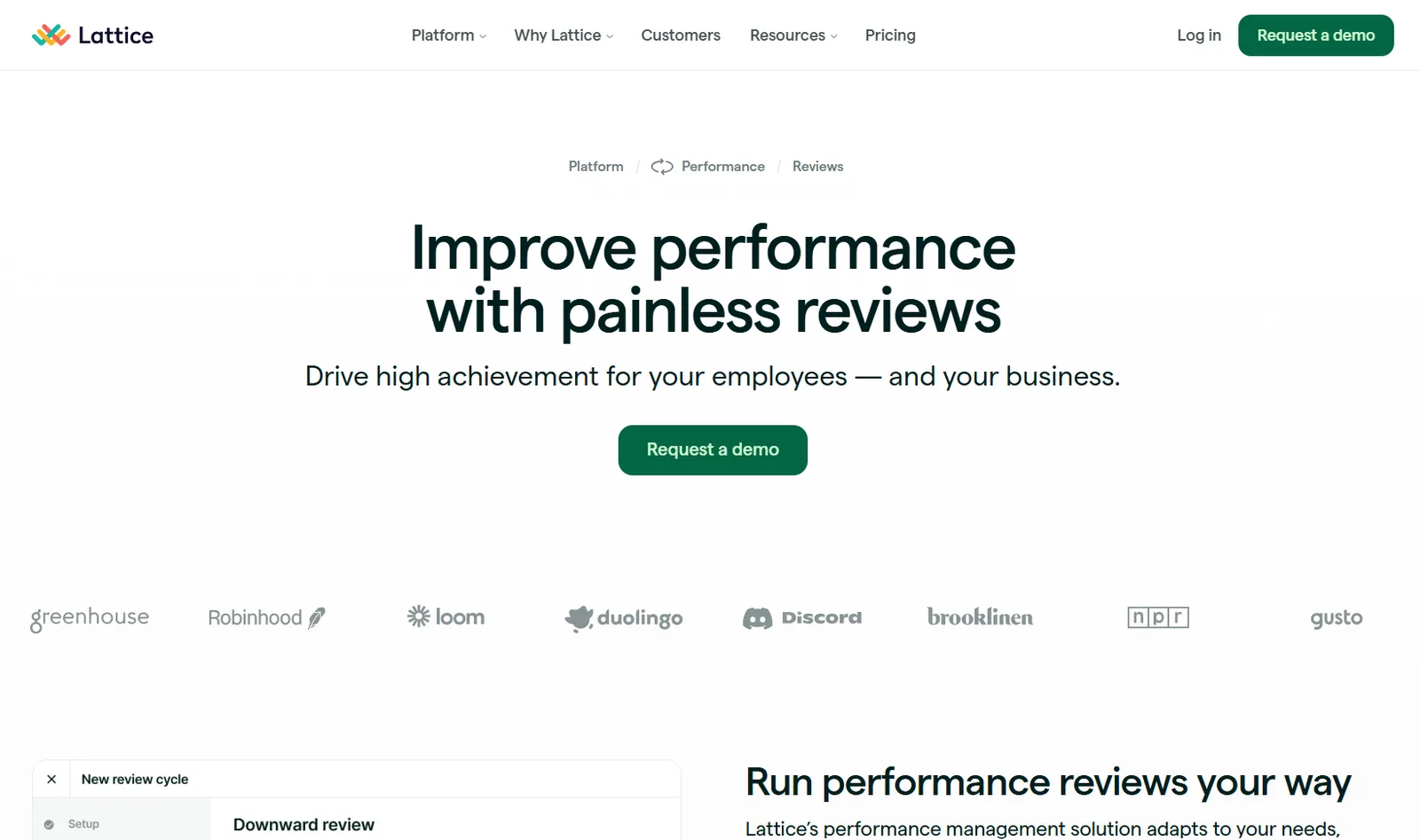
Lattice is an HR platform that brings performance reviews together with engagement, employee development and compensation. Employees can receive text-based 360 feedback from multiple sources, including colleagues at different levels, alongside their own self-assessment.
The platform links review results with goals and regular 1:1s. Feedback collected during the year also becomes part of the employee’s performance record, giving managers more context for development conversations and talent decisions.
Key features
- Multi-directional performance reviews
- Custom review templates and workflows
- AI-powered review drafts
- Performance review calibration
Pricing
- Lattice Performance starts at $10/seat/mo
- Enterprise pricing is available on request
G2 score
4.6 out of 5
What users say
“I use Lattice for performance reviews and engagement surveys. I like that it has created a more streamlined, organized review cycle, allowing for anonymous 360 reviews.”
— Jackie F., an HR professional
11. 15Five
Best for: Manager-led performance and ongoing feedback
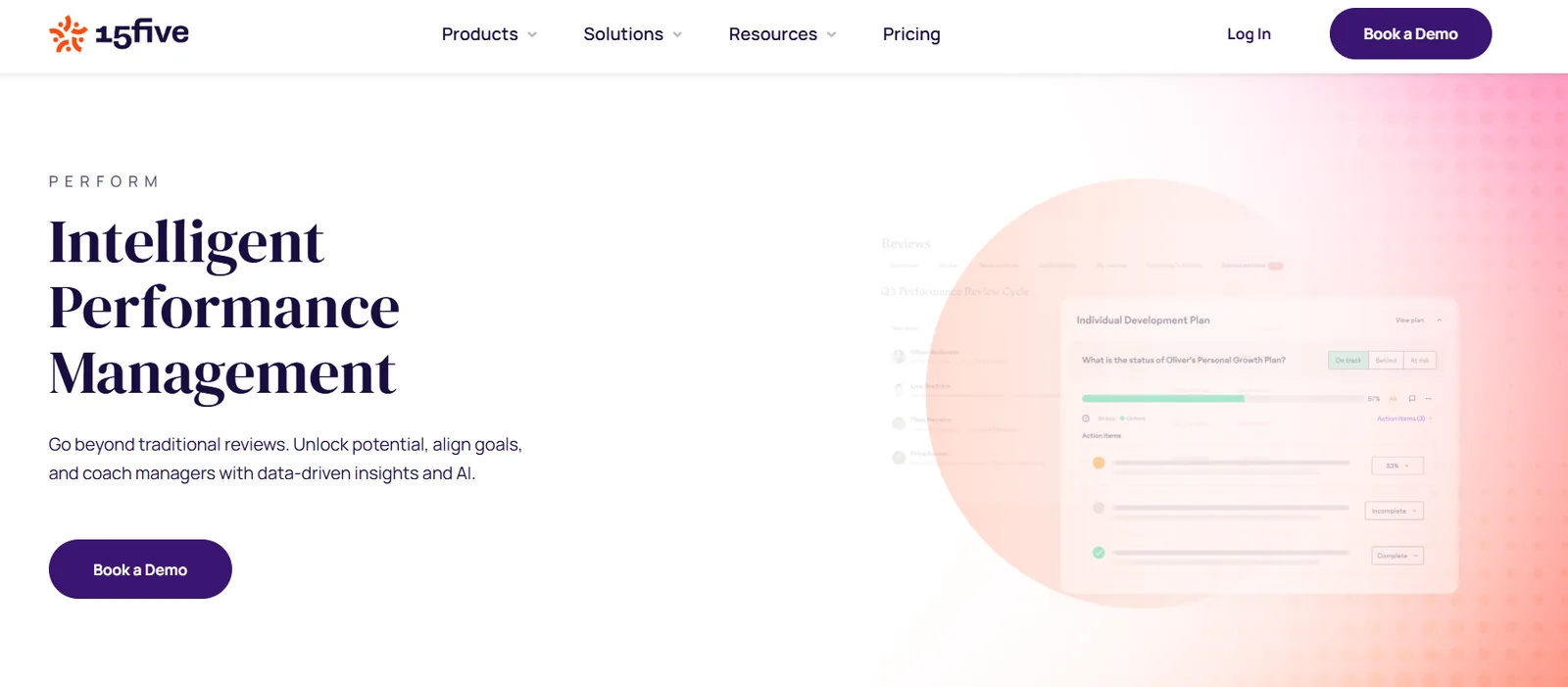
15Five is a performance management platform built around regular feedback between employees and managers. Its Request Feedback feature lets employees choose whether they want positive feedback, constructive feedback, or both.
For formal review cycles, the platform’s Best-Self Review combines self-reflection with feedback from others. The results can then inform ongoing 1:1 conversations, helping employees take ownership of what they work on next.
Key features
- AI-assisted review drafts
- In-app feedback guidance
- Manager effectiveness tools
- Outcomes Dashboard
Pricing
- 15Five Perform starts at $11/user/mo
- Total Platform from $16/user/mo (including everything in Perform plus Manager Microlearning)
G2 score
4.6 out of 5
What users say
“The Best-Self Review module has transformed how we run our semi-annual performance cycles, making it simple to track self-assessments and manage 360-degree review calibrations in one clean space.”
— Anashika K., a people operations manager
12. Leapsome
Best for: Competency-based reviews and employee development
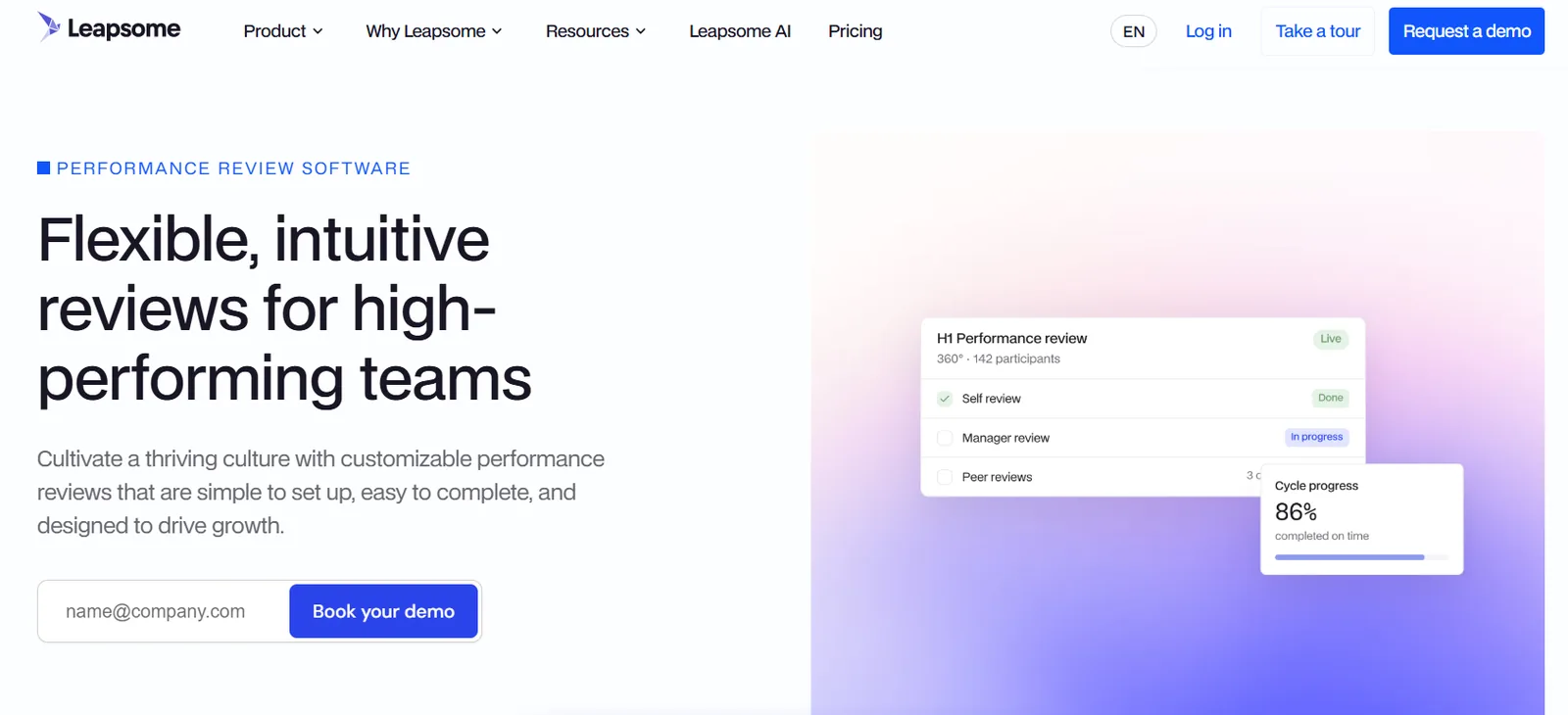
Leapsome is an HR platform with a Reviews module for running structured 360 evaluations. Its development matrix measures performance against defined skills and competencies, allowing teams to track progress over time.
Managers can draw on previous feedback and goal progress when completing reviews. Leapsome AI also turns evaluation notes into clearer comments and suggested actions, helping reviewers provide more useful feedback.
Key features
- Best-practice review templates
- Automated review cycles
- AI feedback summaries and Review Assistant
- Heatmap and nine-box calibration
Pricing
- Pricing is based on the number of employees, contract length (all contracts have a minimum term of 1 year), and the modules you purchase.
- Discounts are available for startups and NGOs
G2 score
4.8 out of 5
What users say
“I appreciate how Leapsome helped us replace spreadsheets with a single platform for performance review and OKRs tracking. The interface is intuitive, and the platform covers everything in one place. The performance review feature is well designed, and the 360 feedback format gives employees a complete balanced view of their performance.”
— Alexis F., an HR professional
13. PerformYard Performance Management
Best for: Highly configurable performance review processes
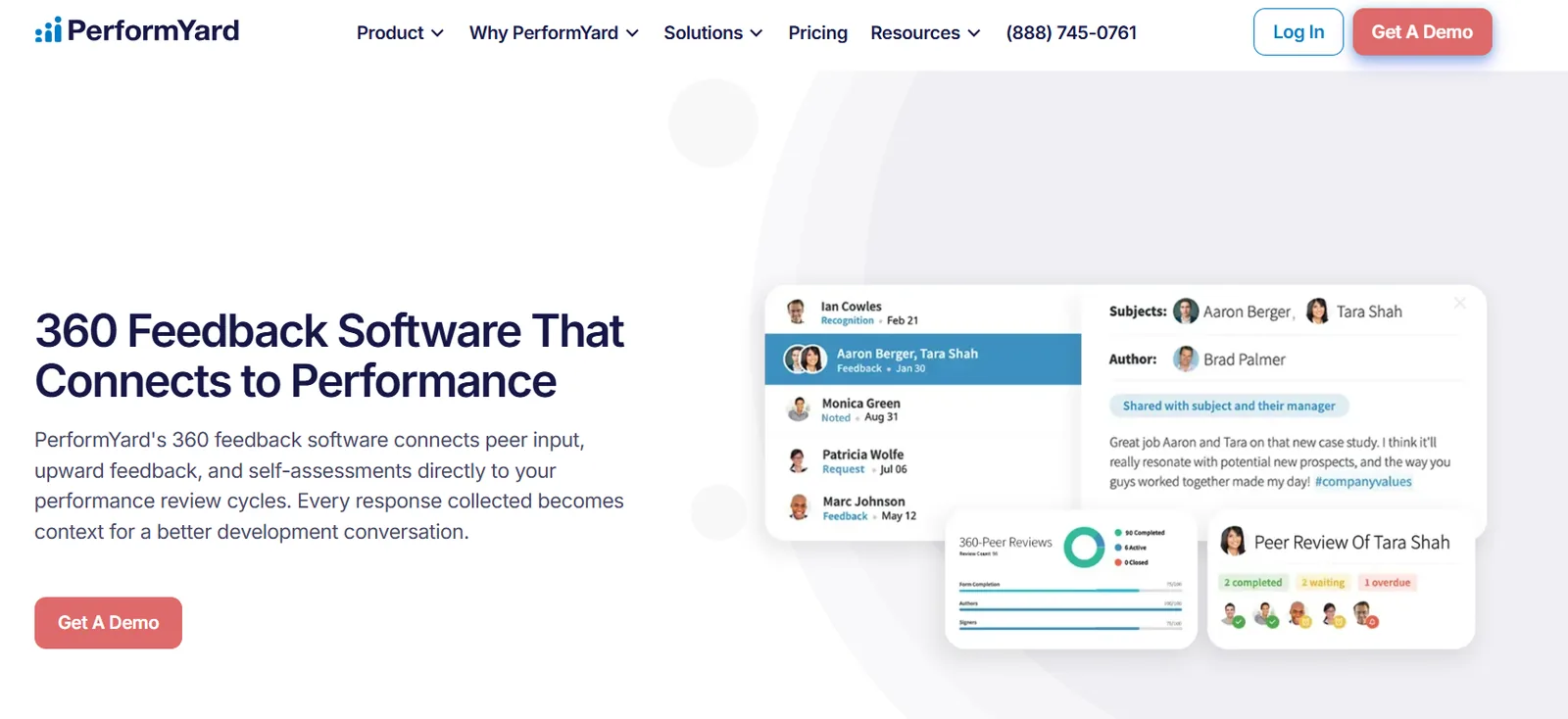
PerformYard is an AI performance management platform designed for teams that want more control over how reviews run. HR teams can recreate an established process or design one around their preferred structure and schedule.
The platform keeps review results alongside other performance activity, giving managers a more complete employee record. PerformYard AI can summarize results, identify recurring themes and recommend follow-up actions.
Key features
- 360-degree feedback
- Timeline-based review cycles
- Project-based reviews
- AI feedback summaries
Pricing
- Pricing from $5-15 per person for the Performance plan
G2 score
4.7 out of 5
What users say
“I like how user-friendly PerformYard is! It’s a great tool for keeping all employee information, evaluations, 360 evaluations, goals, and more in one place. It has made internal and team evaluations so much easier without the hassle of figuring out complex processes.”
— Bryan C., a small business assistant
14. Spidergap
Best for: Consultants and leadership education providers
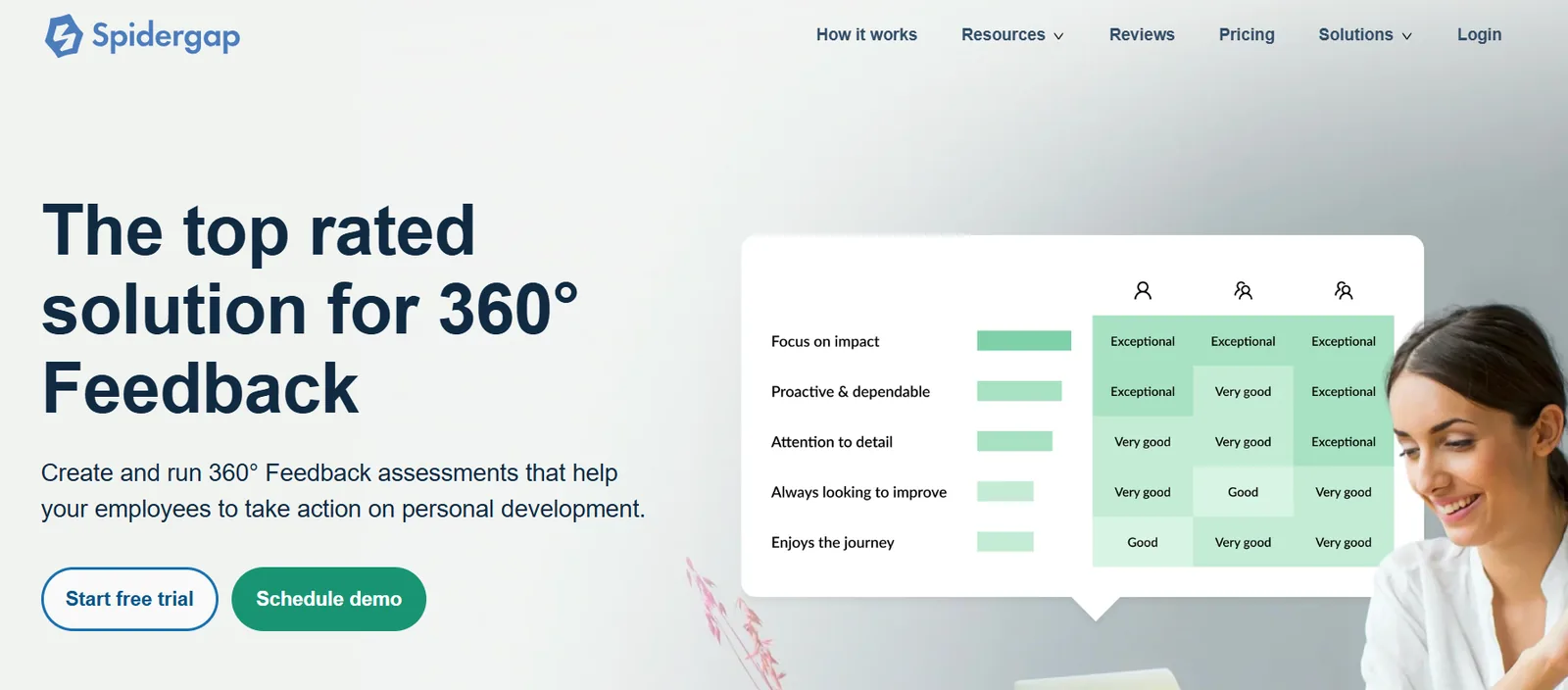
Spidergap is a dedicated 360 feedback platform with tailored options for client-facing practitioners and higher education providers. Consultants can run assessments across multiple clients, while universities can use the platform within MBA programs and leadership courses.
Spidergap turns survey responses into reports that highlight each recipient’s strengths and development priorities. Follow-up impact surveys help providers demonstrate whether the program delivered meaningful results.
Key features
- Multi-client assessment management
- Custom branding for consultants
- Curriculum-aligned questionnaires
- Managed delivery for student cohorts
Pricing
- Starter pricing from $1099 per year for 10 feedback recipients
- Pro pricing from $2199 per year for 10 feedback recipients
- Enterprise pricing is available on request
G2 score
4.5 out of 5
What users say
“The email templates are easy to edit, and so is issuing emails with links to the questionnaire, assessment and reminders.”
— Bilawal A., a senior manager
15. Qualtrics Employee Experience
Best for: Enterprise-wide employee listening and development
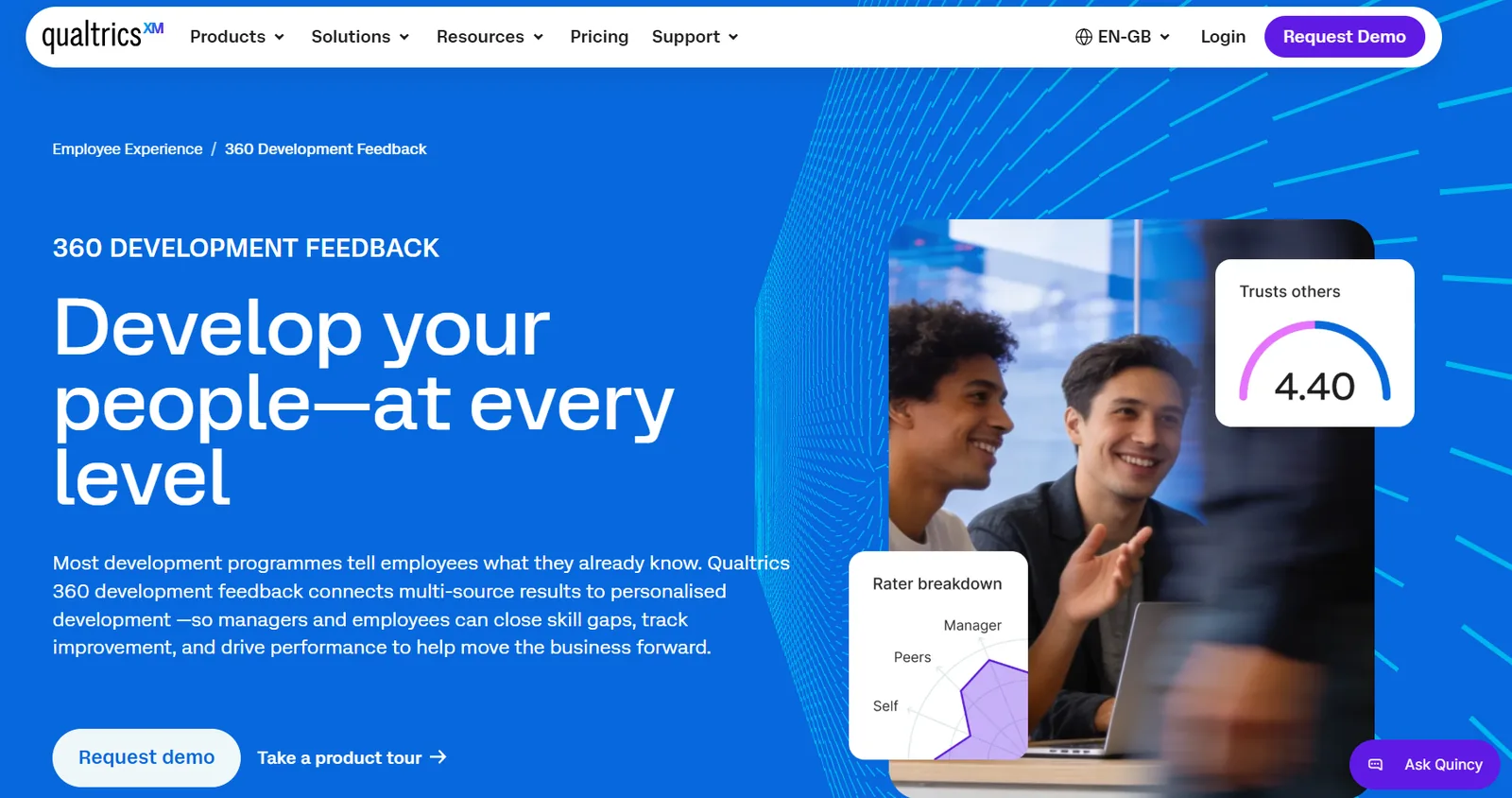
Qualtrics Employee Experience is an enterprise employee listening platform. Its 360 Development Feedback module turns multi-rater results into personalized development plans, allowing organizations to connect feedback with relevant learning resources.
Interactive dashboards show skill gaps across the workforce and track changes over time. Qualtrics can also connect development activity with business KPIs, helping HR demonstrate the impact of its 360 program.
Key features
- Built-in competency templates
- Self-service participant portal
- Automated nominations and routing
- HRIS and LMS integrations
Pricing
- Custom pricing is available from the vendor on request
G2 score
4.4 out of 5
What users say
“360 surveys provide a complete picture of employee satisfaction, which can be helpful in identifying areas of improvement.”
— Kushal R., an enterprise research professional
What to look for in a 360 feedback tool
If you’ve already been researching different 360 feedback vendors, you’ll be familiar with the exhaustive feature lists on offer — and some of the capabilities sound nothing short of impressive. But more features doesn’t necessarily result in a better feedback cycle.
Instead of being swayed by bells and whistles, start by picturing how you want your cycle to work, from the first feedback request to the development that follows. Then use the criteria below to judge whether each platform can support that experience.
- Purpose and use case: Do you need the feedback to support development, performance management, or a wider leadership program? Some tools combine 360s with formal reviews. Others keep the process confidential and development-focused.
- Feedback method and depth: Check whether the tool provides specific examples behind each theme or relies mainly on rating scales and written comments. Guided interviews can probe for examples and explore why someone experiences a behavior in a certain way.
- Confidentiality and anonymity: Ask who can access raw responses and whether comments appear verbatim in the final report. A quote may identify its author, even without their name. If you’re considering an internal agent, think about whether employees will trust the process enough to speak candidly.
- Participant experience: Find out what feedback providers are expected to do and how long the process takes. (Hint: A lengthy form may discourage detailed answers if the feedback provider is trying to rattle through the questions as quickly as possible.) Voice can make feedback easier to give, especially when the tool asks useful follow-up questions.
- Administrative experience: Map out the work required to launch and manage each cycle. Can administrators customize questions, nominate feedback providers, monitor completion, and send reminders automatically? Flexible workflows are vital when different teams need different programs.
- Reporting and team insights: Ask to see a sample report alongside the dashboard screenshots you’ll probably see in a demo. Check whether the output fully explains the behavior behind each observation and resolves any contradictory feedback. Find out whether reports can use your company’s competencies or leadership principles and whether this costs extra. For cohort reporting, check whether you’ll receive qualitative patterns or averaged scores. Confirm the minimum group size and how the platform protects anonymity.
- Development support: Look beyond the moment when the report arrives. Some tools leave recipients to interpret their results alone. Others include a debrief, development plan, or structured follow-up. Ask who delivers the debrief, how long it lasts, and whether it is included in the price. Consider how managers will support progress without gaining access to confidential feedback.
- Pricing and scalability: Compare the total cost of running the program you want and work out the cost per feedback recipient. Some platforms charge for every employee, while others charge only for feedback recipients. Check for implementation fees, coaching costs, minimum contracts, and limits on feedback providers. Ask what a second cycle will cost and whether it will build on the recipient’s previous feedback.
What changes when feedback happens through voice
Many 360 feedback tools share a commonality: the quality of the feedback they manage is limited by what people are willing to type into a box. Voice-based feedback, collected through conversational interviews, goes deeper:
- Feedback providers share more. Speaking is faster and more natural than writing, with the average English speaker sharing 150 words per minute compared to around 40-50 per minute when typing. When conversation flows, people are more likely to elaborate and give contextual examples without being prompted.
- Feedback becomes more specific. Vague survey responses, like “good communicator" or "needs to be more strategic" feel abstract as lone findings in a 360-degree survey. But in a two-way interview format, these points become themes backed by detailed observations with examples.
- Following up on feedback is possible. A conversation can do what a form cannot: ask "Can you tell me more about that?" or "What did that look like in practice?" This probing produces the depth you’d expect from a coaching conversation, rather than leaving the first answer unexplored.
- Feedback completion rates go up. Survey fatigue is real, and most HR teams know the pain of chasing down respondents to complete their part of the cycle. In contrast, participating in a real interaction takes just a few minutes and feels like a normal conversation rather than homework.
For more on the research behind voice-based feedback, see The Truth Deficit, a white paper from Endeavor Intelligence and Your360.
Run a complete voice-led 360 feedback cycle with a debrief included
Talking through the experience of working with someone is an entirely natural process, and produces richer insights than those you’ll find crammed into a form. Your360 is built to deliver this exact experience.
The platform handles the complete process from end to end, from the recipient’s first conversation to their live debrief and growth plan.
Ready to run a full 360 cycle in as little as two weeks? Explore Your360 AI today.
FAQs about 360 feedback tools
What is 360 degree feedback?
360 degree feedback is the process of gathering observations and perceptions about someone from their manager and the people they work with. It helps the recipient understand how others experience their behavior and choose what to develop. Depending on the program, people give feedback through rating surveys or individual interviews that probe for specific examples.
How much does a 360 assessment cost?
The cost of 360 feedback software varies depending on what you’re buying. A broader employee performance platform may charge monthly per employee but fail to collect meaningful insights and link them to ongoing development. Usually, they don’t include a debrief. At the other end of the scale, executive assessments tend to be priced per person, while coach-led programs can cost thousands of dollars. Your360 AI’s voice-based 360s include a live debrief that produces a development plan; the cost is just a few hundred dollars per participant, bringing coaching-level insights to your team at a fraction of the cost.
What is the best 360 feedback tool for small companies?
The best 360 feedback tool for a small company depends on your goal. Lattice or 15Five may suit a small team that also needs performance management. If you want high-quality developmental feedback without committing to an enterprise HR suite, Your360 AI offers a standalone, interview-based 360 platform with a full debrief included. The team plan covers up to eight recipients, while an individual plan is also available.
Can AI replace human coaches in 360 feedback?
AI doesn't need to replace human coaches to be valuable. The real gap in the market isn't at the executive level, where coaching 360s are already available but inaccessible to most employees because of the cost. AI makes coaching-quality feedback available to any size of business; for organizations that also invest in coaching, AI-collected feedback gives coaches richer input to work with.
What's the difference between 360 feedback and performance reviews?
Performance reviews are typically manager-led evaluations tied to pay, promotion, and HR systems. 360 feedback collects input from multiple perspectives (peers, direct reports, managers) and is designed to identify development opportunities. Some organizations integrate 360s into performance cycles, while others keep them separate and learner-owned to maximize psychological safety and candor.
How do you get people to complete a 360?
Completion rates are one of the biggest operational challenges with 360 feedback. Survey fatigue, unclear expectations, and the effort of typing thoughtful responses all contribute to low response rates. Voice-based approaches address this directly with a 15-minute conversation they can join from a phone or browser. Instead of feeling like homework, it’s like talking to a colleague, and it’s faster than filling out a form. This approach to 360s consistently produces higher completion rates because giving feedback by talking is easier than writing it.
What is the best 360 feedback tool for leadership development?
The best 360 feedback tool for leadership development depends on what you need the leader to walk away with. For interview-depth feedback with the debrief and development plan included, at a fraction of the cost of coaching programs, Your360 AI is the strongest choice. Alternatively, Korn Ferry, CCL, Hogan, and FranklinCovey are all well-established choices if you’re looking for a competency model debriefed by certified coaches. If you prefer mindset-focused, practitioner-led work then Leadership Circle may be a good fit, while BetterUp’s 360 will be the natural choice if you’re already using the platform for coaching.
Why is the debrief so important?
The debrief is a vital part of the feedback process because it helps the recipient interpret the findings and turn them into a development plan. Without this support, feedback can do more harm than good. A landmark study by Kluger and DeNisi found that feedback reduced performance in about a third of cases. A debrief can also be one of the most expensive parts of a 360 because it usually requires a certified coach’s time. Your360 AI includes a live debrief for every recipient.
Is an interview-based 360 better than a survey 360?
Yes, interview-based 360s produce richer, more specific feedback than survey 360s because the interviewer can ask follow-up questions and draw out examples. Surveys scale more easily but their success and value depends entirely on what raters choose to type and the strength of their written communication. Voice AI now makes interviews possible at a fraction of the cost of a coach-led program.