
Leadership
Blog
We have a confession to make: we are tired of looking at "green" dashboards. You know the ones—the Learning Management System reports that proudly declare a 78% completion rate for the latest leadership training module (a solid number, given that voluntary modules often stall at 60%), or the engagement survey results that boast 85% participation (hitting that "excellent" 80-90% benchmark). For many Heads of L&D, these numbers are the primary currency of the trade because they are quantifiable, reportable, and look exceptional in a board deck. When the C-suite asks for ROI, pointing to a "fully trained" workforce is the path of least resistance, but it is a path that leads away from actual impact.
Completion is not competence, and participation is not engagement. In fact, high completion rates often mask a deeper, more insidious problem: compliance culture masquerading as learning culture. We are confusing the activity of training with the impact of learning. Organizations frequently default to a culture of compliance where training is a risk-mitigation checkbox rather than a growth engine. We push employees to finish the course so we can tell the regulators or the CEO that the box is checked, but the organization isn't actually getting any smarter.
The Rise of the "Armored" Learner
Brené Brown’s research into leadership distinguishes between "Armored Leadership" and "Daring Leadership." Armored leadership is driven by self-protection; it is the behavior we adopt when we are afraid of being seen as wrong, weak, or incompetent. When we design L&D programs that prioritize finishing over feeling, we are essentially incentivizing armored learning.
Consider the typical corporate e-learning experience. Employees click "Next, Next, Finish" to protect their time. They provide safe, neutral feedback in 360 reviews to protect their professional relationships. They are completing the task to avoid the shame of non-compliance, but they are not opening themselves up to the discomfort of actual growth. Brown notes that armored leaders need to be "knowers" rather than "learners." By reducing learning to a completion metric, we reinforce the idea that the goal is to have already known the material, rather than to wrestle with it.
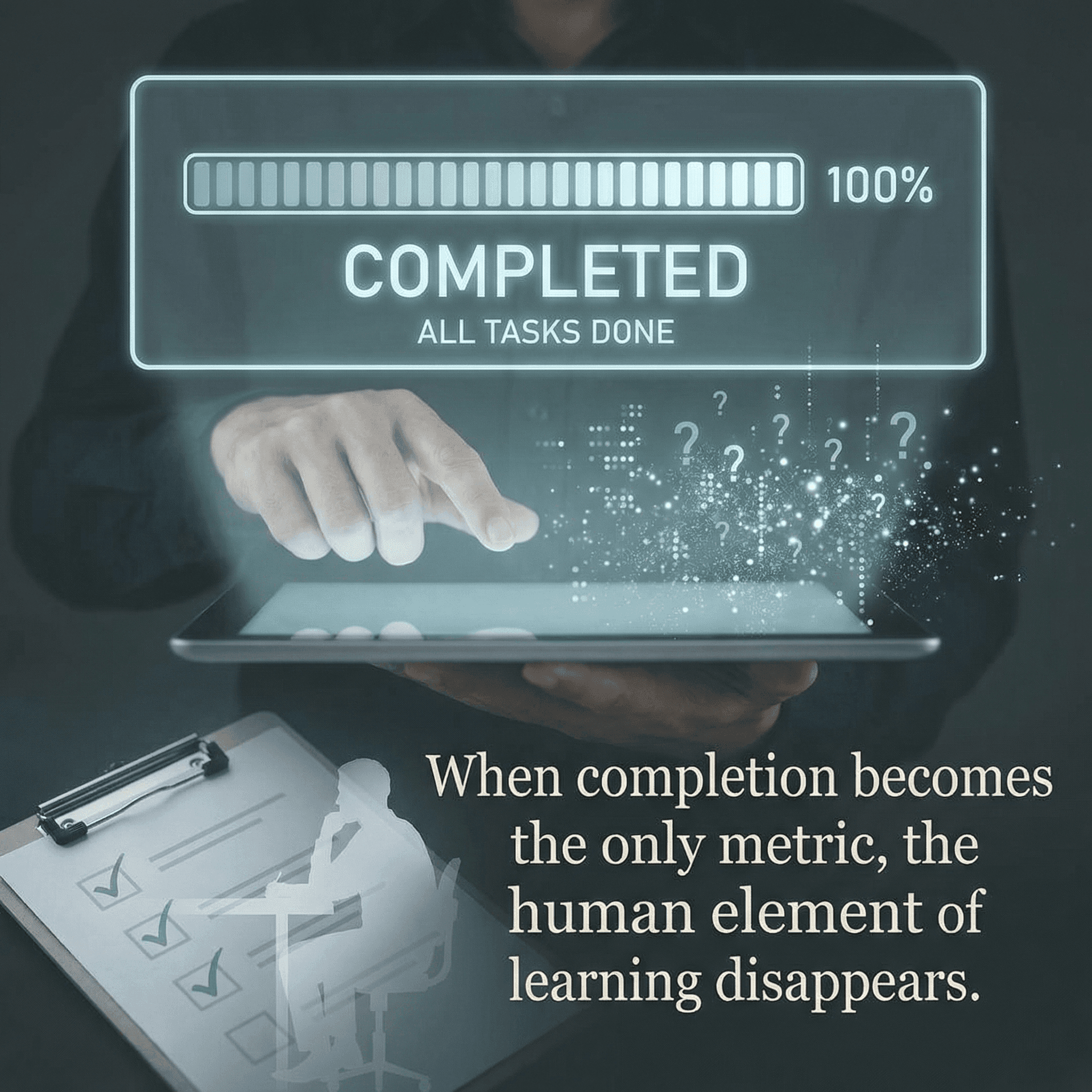
When completion becomes the only metric, the human element of learning disappears.
As the saying goes, "Clear is kind." But current feedback loops—static surveys and checkbox reviews—are anything but clear. They are vague, performative, and safe. They are designed for data collection, not human connection.
The Psychological Safety Gap
Adam Grant has argued for years that psychological safety is the bedrock of organizational learning. Without it, people don't rethink their positions; they just repeat what is safe. Psychological safety isn't about being "nice"; it’s a climate where people feel safe to take interpersonal risks—like admitting a mistake or challenging the status quo—without fear of punishment.
Traditional feedback mechanisms, such as manager-led reviews or text-based surveys, often ignore the power dynamics that destroy this safety:
- Structural Risks: Managers control promotions and bonuses. It is inherently unsafe to be vulnerable with the person who holds the keys to your career progression.
- The Stylometry Problem: "Anonymous" text boxes don't feel anonymous when you have a unique writing style. Employees self-censor because they know their manager can hear their unique "voice" in the text.
Consequently, people provide the feedback they think is expected, not the feedback that is true. We get high completion rates on our feedback cycles, but zero actual insight. We are measuring the thickness of the armor, not the depth of the learning.
Moving From "Did They Finish?" to "Did They Grow?"
The mechanism of listening matters more than the metric of completion. To break through the armor, organizations need a medium that feels human but removes the judgment of a human. This is where Voice AI changes the equation.
Unlike a static, one-way survey or an expensive, intimidating human consultant, an AI coach acts as a neutral bridge. It has no agenda, no history with the employee, and no place on the organizational chart, which removes the political risk of feedback. Because the AI is inherently curious, it can probe for specifics—asking "Can you say more about that?"—rather than accepting vague platitudes.
Research shows that people are often more honest with machines than humans because the fear of social judgment is removed. This turns a checkbox exercise into a deep-dive interview, allowing organizations to stop collecting "data" and start collecting truth. We move from measuring how many people clicked a button to understanding how many people actually had a breakthrough.
The New L&D Scorecard
It’s time to retire the vanity metrics. If we want to build a true learning culture defined by daring leadership and psychological safety, we must change what we measure. Real learning is messy and vulnerable. it doesn’t always fit neatly into a pie chart, but it’s the only thing that actually moves the needle.
Don't tell us how many people finished the module. Tell us how many people felt safe enough to admit they were struggling. Don't tell us the participation rate of the 360. Tell us about the depth of the insights received. Let’s stop counting clicks and start listening to voices.
Ready to move beyond completion rates? Discover how Your360.ai can help you build a culture of real learning and psychological safety.