
Leadership
Blog
The search for a 360 assessment vendor usually begins with a familiar, exhausting ritual: endless spreadsheets of feature sets, checklists that grow with every stakeholder meeting, and a sense of dread regarding the administrative burden ahead. But as organizations attempt to navigate this process, a stark reality remains: traditional feedback tools are failing. Most existing solutions simply digitize an old problem, turning paper-based headaches into tedious, text-heavy surveys that employees actively avoid. Yet, according to PwC's Global Workforce Hopes and Fears Survey 2025, motivation thrives where employees feel safe and find meaning—something static forms fail to provide.
Research indicates that traditional surveys suffer from staggering incompletion rates, often hovering between 30% and 40%. When the barrier to entry is a 45-minute typing marathon, the quality of feedback evaporates. Participants often resort to vague, short answers just to finish the task, leaving leaders with data that lacks the nuance required for real growth. The market is shifting away from these static, text-based interactions toward dynamic, voice-based interviews that prioritize the human element over the checkbox.
The Insight Gap: Data vs. Understanding
In recent years, the market has been flooded with overnight feedback tools that lack deep roots in industrial-organizational psychology. These platforms are efficient at collecting data, but they struggle to capture insight. High-quality feedback doesn't fail because people lack the will to help their colleagues; it fails because the tools strip away the context and emotion that make feedback useful.
While subject matter experts are essential for ensuring that leadership competencies remain relevant, the delivery mechanism is where the real battle for engagement is won. Modern vendors are now leveraging Voice AI to act as a neutral, agenda-free listener. As noted in a 2025 McKinsey report on AI in the workplace, employees are ready for technology that empowers them. This technology creates a safe space for radical candor, allowing feedback providers to speak naturally rather than performing for a text box. The goal is to move beyond automating a paper process and instead use technology to enhance human connection.
Moving Beyond the 'File and Forget' Report
Perhaps the most significant failure of the traditional 360 model is the output. Historically, the process culminates in a dense, 30-page PDF report. These documents are comprehensive but often suffer from the 'file and forget' phenomenon. They provide a mountain of data but lack the synthesis required for immediate action.
We know that feedback without coaching is largely wasted. However, traditional human coaching is a luxury, often costing between $3,000 and $10,000 per person. This price tag effectively gates professional development, reserving it only for the C-suite. A new generation of vendors is democratizing this experience through AI-driven synthesis.
For example, solutions like Your360 AI utilize an AI Coach, such as 'Tam,' to guide every employee through their results. Instead of staring at a confusing heatmap or a static dashboard, the employee engages with a synthesized coaching plan. This allows them to process feedback privately and build an actionable growth plan immediately, turning raw data into a clear path for development.
The Efficiency of Voice vs. The Friction of Text
When evaluating potential partners, the input method is the most critical variable for participant engagement. The difference between typing and speaking is not just a matter of convenience; it is a matter of depth.
| Feature | Traditional Text Surveys | Voice AI Feedback |
|---|---|---|
| Time Investment | 45+ minutes of typing | ~10 minutes of speaking |
| Completion Rates | 60-70% (30-40% incompletion) | Significantly higher due to low friction |
| Depth of Insight | Short, vague, or 'sugar-coated' | Rich, nuanced, and context-heavy |
| Emotional Context | Lost in translation | Captured through tone and inflection |
In pilot programs, a 10-minute voice conversation consistently yields richer insights than 45 minutes of typing. One participant noted that a single 20-minute session extracted more meaningful detail than an hour of writing ever could. Voice interfaces enhance emotional and cognitive engagement, allowing the AI to probe deeper with questions like, 'Can you give me an example of that?'—a capability static forms simply cannot match.
This isn't just anecdotal. Research led by Justin Kruger at NYU highlights a sobering reality: while we believe we are being clear in text, recipients identify the correct tone—distinguishing between seriousness and sarcasm, for instance—only 56% of the time. That is barely better than a coin flip. When that same message is spoken, accuracy jumps to 73%. Read the study here.
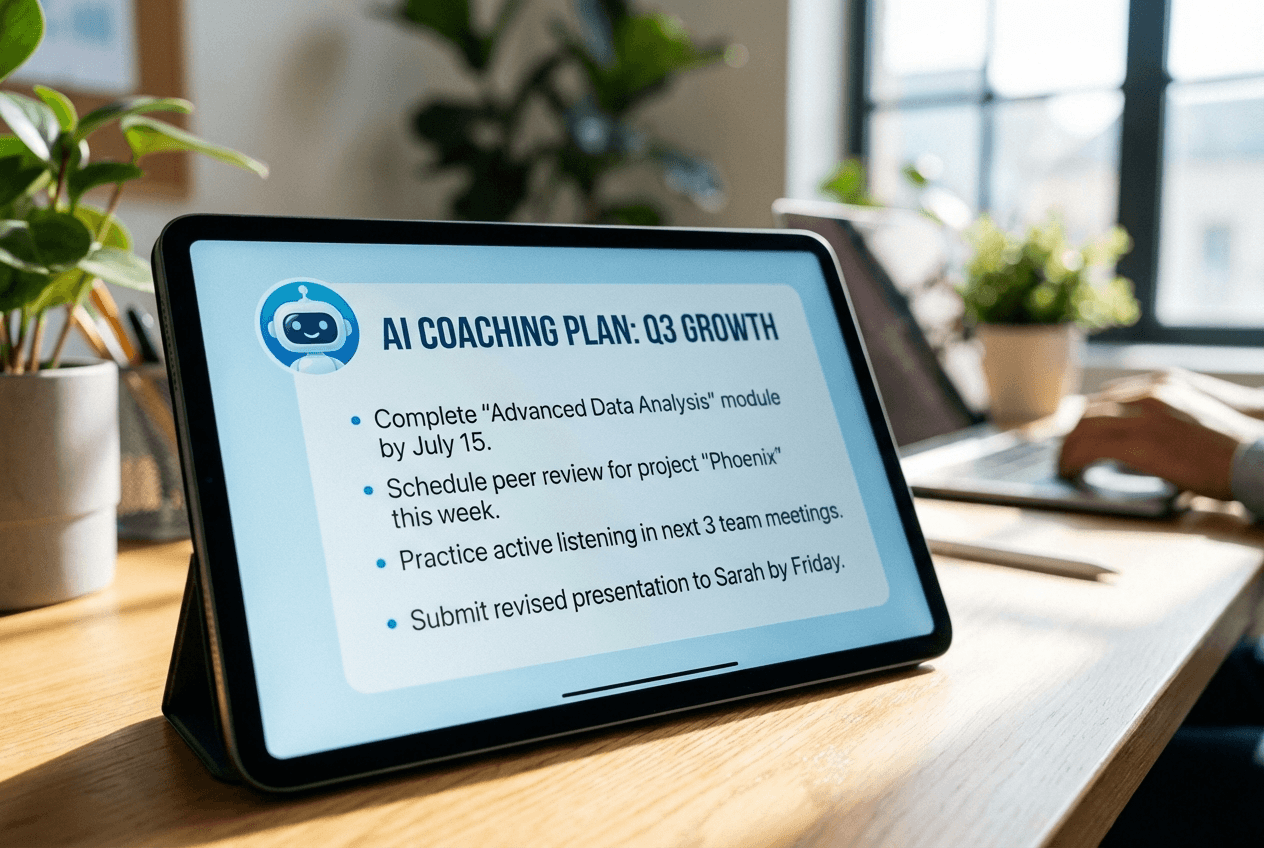
AI-driven synthesis turns overwhelming data into a focused, private coaching experience for every employee.
Security, Privacy, and Psychological Safety
Security is often treated as a baseline administrative checkbox involving Single Sign-On (SSO) and encryption. While these are essential, the real security concern in a 360 assessment is psychological safety. Research on psychological safety and learning behavior shows that team structures explain most of the variance in effectiveness. If employees do not feel safe, they will not be honest.
Traditional manager-led reviews or non-anonymous surveys frequently lead to polite, sanitized responses that avoid the 'blind spots' that actually matter. The use of AI acts as a vital privacy shield. By anonymizing voice data, these systems ensure that feedback providers can speak freely without fear of retribution. When choosing a vendor, ensure they provide enterprise-grade security—including encryption in transit and at rest—but also investigate how they protect the anonymity of the speaker to foster a culture of honesty. Studies confirm the power of psychological safety in impacting team dynamics and productivity.
Strategy for Implementation
The success of a 360 program relies on how it is framed. Organizations should prioritize a development-focused approach rather than a performance-rating approach. When feedback is decoupled from compensation and formal ratings, employees are more likely to embrace the vulnerability required for genuine growth.
Change management becomes significantly easier when the tool doesn't feel like 'work.' Traditional 360s require heavy lifting, constant reminders, and a significant administrative burden. A voice-based approach allows people to give feedback while walking the dog or between meetings. When the process fits into the natural flow of a workday, adoption skyrockets and the cycle of data collection shrinks from weeks to days.
The Bottom Line
The 360 landscape has evolved past the era of the static survey. Organizations are no longer limited to choosing different flavors of the same tedious questionnaire. The choice today is between static data collection and dynamic, voice-powered growth.
If the process doesn't change, L&D leaders will continue to struggle with engagement and actionable insights. By selecting a partner that leverages Voice AI to ensure psychological safety and depth, you can bring executive-quality coaching to every level of your organization. The future of feedback isn't found in a text box; it's found in the human voice.
To learn more about how Your360 AI can transform your team's feedback culture, visit your360.ai.