
Security
Blog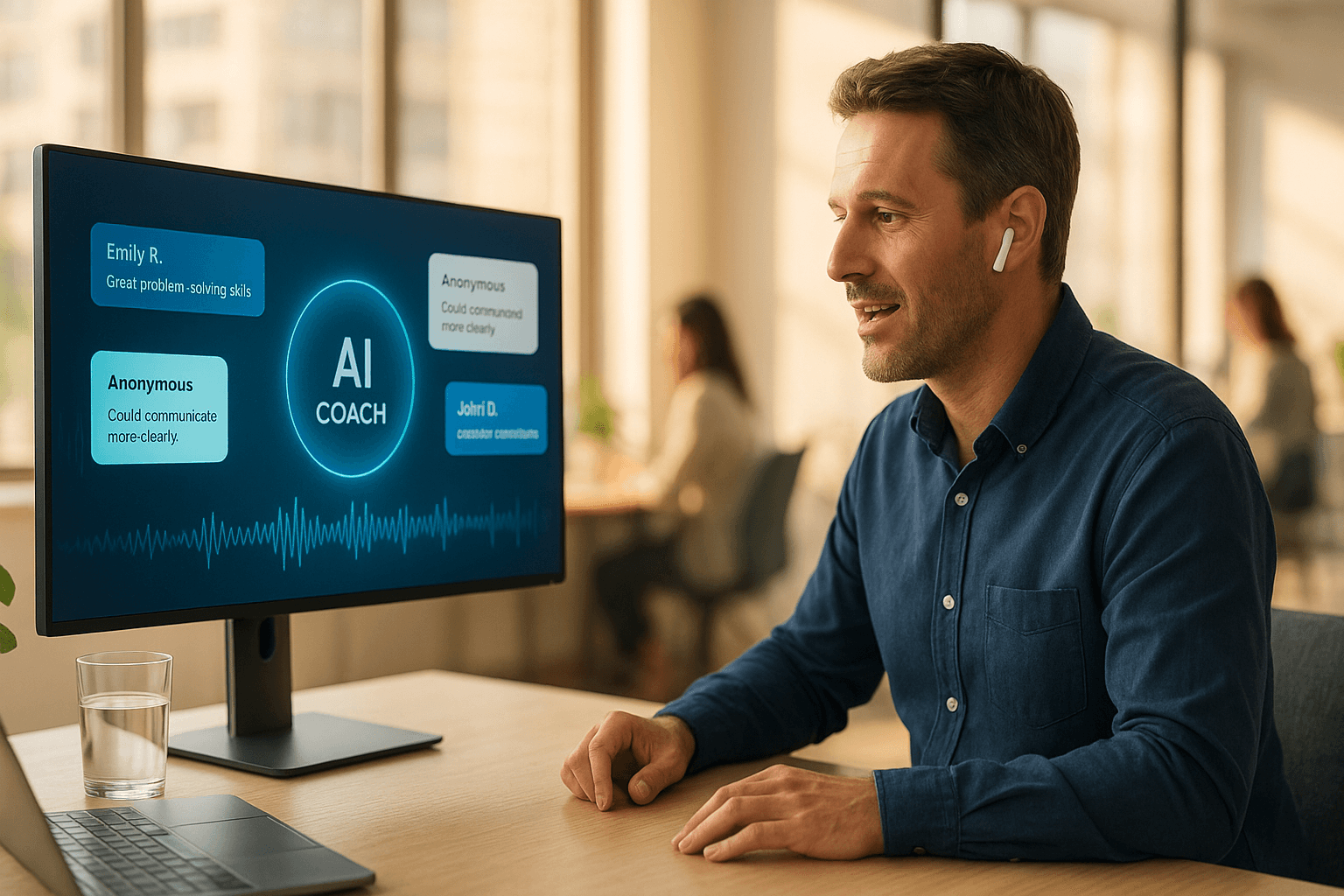
- Traditional 360 surveys claim anonymity but rarely deliver true psychological safety
- Kim Scott's Radical Candor and Amy Edmondson's research both confirm: people self-censor when they fear consequences — even in "anonymous" systems
- The fix isn't better survey software — it's removing the human power dynamic from feedback collection entirely
- Your360 AI's voice-based approach, powered by AI coach Tam, creates the conditions where honest peer feedback actually happens
- Key use cases: Leadership Development 360s, New Manager Acceleration, Team Effectiveness, Organizational Change Check-Ins, Succession & Hi-Po Development, and more
Why "Anonymous" Surveys Aren't Actually Confidential
Ask any OD leader or internal coach whether their 360 surveys are confidential, and they'll say yes. Ask the employees filling them out, and you'll hear something very different.
"I know my manager will figure out it was me."
"There are only four people on my team. It's not hard to guess."
"I wrote something honest once. Things got awkward for months."
This is the confidentiality gap — and it's the single biggest reason 360 feedback fails to drive real behavior change. We can build the most sophisticated survey platform in the world, but if the person giving feedback doesn't believe their identity is protected, they will self-censor. Every time.
Research on anonymous versus open evaluative feedback consistently shows that perceived anonymity — not just technical anonymity — determines whether people share honest assessments. The difference matters enormously for OD practitioners designing feedback systems.
The data on what's at stake is stark. According to Gallup's research on how effective feedback fuels performance:
The problem isn't that people don't want feedback. It's that the tools we use to collect it make honesty feel dangerous.
What Kim Scott's Radical Candor Tells Us About Why People Stay Silent
Kim Scott, author of Radical Candor and a former executive at Google and Apple, has spent her career studying why honest feedback is so rare in organizations. Her conclusion is uncomfortable: the problem isn't that people don't have honest opinions. It's that the organizational environment makes sharing them feel dangerous.
Scott identifies two failure modes that are directly relevant to 360 design:
Kim Scott's Two Failure Modes in Feedback Systems
Ruinous Empathy — giving vague, watered-down feedback to avoid discomfort. This is what most 360 surveys produce. Respondents write things like "great communicator" or "could improve on delegation" — technically feedback, but practically useless.
Manipulative Insincerity — saying what you think the system wants to hear, not what you actually believe. When employees suspect their responses will be traced back to them, this is the default mode.
Scott's framework makes clear that psychological safety is the prerequisite for Radical Candor — not the other way around. You cannot ask people to be radically candid in a system that doesn't first make them feel safe.
For OD leaders and internal coaches, this is the design challenge: how do you build a feedback mechanism that creates genuine psychological safety before asking for honest input?
Renata Bell, Co-Founder of Your360 AI, has lived this tension firsthand:
"I have always been a fan of the Radical Candor methodology, but I've rarely seen people use it regularly. Knowing that you can have AI not just deliver radical candor, but do it 100x better than most managers could — that's a gamechanger." — Renata Bell, Co-Founder, Your360 AI
Amy Edmondson's Research: The Science Behind Why Confidentiality Matters
Harvard Business School Professor Amy Edmondson coined the term "team psychological safety" in the 1990s, defining it as "a shared belief held by members of a team that the team is safe for interpersonal risk-taking."
Her landmark research, replicated across industries and organizational types, found that psychological safety is the #1 predictor of team learning behavior and performance. Teams that feel safe to speak up, admit mistakes, and share honest assessments consistently outperform those that don't.
Google's Project Aristotle — a multi-year study of hundreds of teams — confirmed Edmondson's findings: psychological safety was the single most important factor distinguishing high-performing teams from average ones. Not talent. Not resources. Not strategy. Safety.
What does this mean for 360 feedback design? It means that the format of feedback collection is not a neutral choice. A survey that technically promises anonymity but is administered by HR, reviewed by managers, and stored in a performance system is not psychologically safe — regardless of what the privacy policy says.
Four steps to building psychological safety from Edmondson's own HBS research include: framing the work as a learning problem, acknowledging your own fallibility, modeling curiosity, and setting up structures for input. Notice what's absent: a survey form.
Rebecca Glenn, Your360 AI Advisor and co-author of Fearless Feedback: A Guide for Coaching Leaders to See Themselves More Clearly and Galvanize Growth, puts it plainly:
"I've spent my career helping leaders embrace fearless feedback. What excites me about Your360 AI is how it democratizes that process — bringing executive-level coaching insights to every professional." — Rebecca Glenn, Executive Coach & Your360 AI Advisor
The Four Power Dynamics Problems in Traditional 360s
Here's what we know about how traditional 360 feedback actually works in practice:
The small team problem. When a team has five people and three responses are required, the math makes anonymity impossible. Respondents know this. They write accordingly.
The HR intermediary problem. Even when surveys are "anonymous," someone in HR sees the raw data. Someone compiles the report. Someone decides what gets shared with the manager. Each human touchpoint is a potential leak — and employees know it.
The performance system problem. When 360 data lives in the same platform as performance ratings, compensation decisions, and promotion records, the developmental intent is undermined. Feedback becomes evidence, not insight.
The recency problem. Written surveys capture a snapshot. They miss the nuance of how someone actually communicates under pressure, how they respond to conflict, or what their peers genuinely think about their leadership style. Context disappears.
Leonard Rodman, AI consultant and L&D practitioner with 20 years of experience, described the pattern bluntly in a widely-shared post:
"Most 360 reviews are worthless performance theater. HR sends a survey. People stress over wording. Managers read a PDF three months later and nothing changes. Meanwhile your top performers are flying blind. No awkward power dynamics with your boss moderating feedback. No guessing who said what. No HR committee rewriting the truth until it is bland and useless." — Leonard Rodman, AI Consultant & L&D Practitioner
As we explored in our article Escaping the Feedback Trap: How OD Leaders Can Ditch Performance Theater for Real Growth, most organizations are trapped in exactly this cycle — elaborate feedback systems that produce polite, vague commentary that doesn't change behavior.
Why Voice AI Changes the Confidentiality Equation for 360 Reviews
The breakthrough insight behind Your360 AI is simple but profound: people are more honest based on who is asking, not just where the data goes.
When a peer gives feedback through a written survey, they're imagining their colleague reading it. When they give feedback through a voice conversation with an AI, that mental model shifts entirely. They're talking to a neutral, agenda-free listener that has no stake in the outcome, no relationship to protect, and no power over anyone's career.
Renata Bell describes what the team discovered in building the platform:
"Voice changes everything. When people talk instead of type, they naturally share specific stories and examples they'd never take time to write. The AI coach also prompts them with follow-up questions, peeling the layer of the feedback to make it more specific. The AI removes the social anxiety or politics of human feedback but keeps the nuance of conversation — it's the sweet spot we didn't know existed." — Renata Bell, Co-Founder, Your360 AI
This is why Your360's AI coach, Tam, consistently surfaces feedback that written surveys miss. Tam:
- Asks adaptive follow-up questions based on what the respondent says
- Probes for specifics when answers are vague ("Can you give me an example of that?")
- Creates a conversational rhythm that feels natural, not interrogative
- Has no organizational affiliation, no memory of past interactions, and no agenda
- Allows feedback providers to participate on their own time — even on a walk — removing the friction of "staring at a blank screen"
The result is feedback that sounds like what people actually say to their most trusted colleagues — not what they write in a form they know will be reviewed.
As we noted in Why L&D Leaders Are Embracing Voice-Based Feedback: "When employees know they're talking to an AI — not a 'boss behind a curtain' — they're often more candid. They feel heard. They don't have to filter or edit themselves for HR."
How Your360 AI Delivers Truly Confidential 360s: Key Use Cases for OD Leaders
For OD leaders and internal coaches designing feedback programs, here's how Your360 AI's specific capabilities address the confidentiality challenge across the most common use cases:
1. Leadership Development 360s — Executive-Quality Feedback Without Consultants
⚠ The confidentiality challenge: Senior leaders are the hardest people to give honest feedback to. Power dynamics are most acute at the top.
✓ How Your360 solves it: Voice-based interviews with Tam remove the power dynamic entirely. Respondents speak to a neutral AI, not to a system that reports to the leader's boss. The result: executive-quality feedback — clear, prioritized development themes — without the cost or bias of human-facilitated coaching.
2. New Manager Acceleration — Shorten Time-to-Effectiveness
⚠ The confidentiality challenge: New managers are in the most vulnerable position — their direct reports are reluctant to give honest feedback to someone who controls their performance reviews.
✓ How Your360 solves it: Early insight into leadership blind spots, gathered from direct reports and peers through voice conversations that feel safe. Targeted growth plans for the first 90 days, built on feedback that's actually honest.
3. Team Effectiveness & Alignment — Clear, Actionable Team Growth Themes
⚠ The confidentiality challenge: Team dynamics are the most politically sensitive feedback context. Colleagues protect relationships. Honest assessments of friction patterns rarely make it into written surveys.
✓ How Your360 solves it: Aggregated strengths and friction patterns surface through voice conversations. Behavioral themes impacting performance become visible. Facilitated focus areas give leaders something concrete to act on — without exposing individual respondents.
4. Organizational Change Check-Ins — Real-Time Signal During High-Risk Moments
⚠ The confidentiality challenge: During reorgs, layoffs, or leadership transitions, employees are most guarded. The stakes of being identified as a dissenter feel highest precisely when honest input is most needed.
✓ How Your360 solves it: Surface trust, morale, and clarity gaps in real time. Identify leadership pressure points early. Turn disruption into focused action — with feedback that employees would never put in writing.
5. Succession & Hi-Po Development — Data-Driven Readiness Insights
⚠ The confidentiality challenge: High-potential employees are often the most politically exposed. Honest feedback about their readiness gaps is exactly what gets filtered out of traditional systems.
✓ How Your360 solves it: Reveal leadership gaps before promotion. Identify influence and trust signals. Support targeted development planning — with the candor that only a neutral AI can unlock.
6. Organizational Insight for HR Leaders — Strategic Visibility Beyond Individual Reports
⚠ The confidentiality challenge: Aggregating individual feedback into organizational insight without compromising individual confidentiality is technically and ethically complex.
✓ How Your360 solves it: Aggregated strengths and systemic themes, with pattern recognition across functions or levels. Feedback translated into company-wide priorities — without individual attribution.
What "True Confidentiality" Actually Looks Like: A Practical Evaluation Framework
For OD leaders and internal coaches evaluating 360 tools, here's a five-question audit to determine whether a platform delivers genuine confidentiality — not just the appearance of it:
The 5-Question Confidentiality Audit for 360 Tools
- Who collects the feedback? If a human is involved in collection — even a trusted HR partner — psychological safety is compromised. The gold standard is a neutral, non-human collector.
- Who sees the raw data? If anyone in the organization can access unprocessed responses, confidentiality is theoretical, not real. Look for systems where synthesis happens before any human reviews the output.
- What does the respondent believe? Technical anonymity and perceived anonymity are different things. The best systems make the confidentiality mechanism visible and understandable to respondents — not buried in a privacy policy.
- Is the feedback system separate from the performance system? When developmental feedback lives in the same platform as performance ratings, the developmental intent is undermined. Separation matters.
- Does the format encourage honesty? Written forms invite editing and self-censorship. Voice conversations, especially with a neutral AI, invite candor.
The OD Leader's Case for Voice-Based 360s: What Users Actually Experience
We've worked with OD leaders and internal coaches who've tried every major 360 platform on the market. The pattern is consistent: the tools that produce the most actionable feedback are the ones that make respondents feel genuinely safe.
That's not a feature. It's a design philosophy.
The Hidden Cost of Performative Feedback explores how check-the-box review cycles erode trust over time. Each round of feedback that produces nothing actionable makes the next round harder. Employees learn that honesty doesn't matter — so they stop offering it.
Voice AI breaks this cycle. Not because it's a better survey. But because it's a fundamentally different kind of conversation. Here's what users say:
"The voice-based AI interviews made sharing insights feel natural and effortless. It translated that feedback into a clear growth plan I could put into practice right away. It truly makes executive-level coaching accessible to every professional, not just those at the top." — Terrell Morrow, VP of Product at Teamfront
"In 25 minutes, Your360's onboarding revealed more than several coaching sessions. And thanks to the report, I'm implementing changes I never would have discovered." — VP Engineering, Upwork
"This one 20-minute session got more out of me than I would have in an hour of writing." — Katrina Benjamin, Chief Product Officer, Axiom Law
"I see so much potential in AI-driven solutions for leadership 360s, and your360.ai is the first tool I've found that truly reimagines what's possible. Instead of asking feedback givers to complete long surveys, write essays, or schedule live calls, feedback givers simply speak to an AI-led voice interview in 15–20 minutes on their time, producing insights that are far more nuanced and actionable." — Heather Doshay, Founder, Waypoint Works
Bobby Land, CPTO at Teamfront, shared what happened when his entire team went through the process:
"Your360 AI transformed our approach to feedback, laying the groundwork for a culture where insights could drive immediate action rather than bureaucratic processes. It positioned our team to operate with greater agility and higher performance, using continuous feedback to stay ahead in our fast-moving industry." — Bobby Land, Chief Product & Technology Officer, Teamfront
Frequently Asked Questions About Confidential Peer Feedback in 360 Reviews
The tool that best ensures peer feedback stays truly confidential is one that removes human intermediaries entirely. Voice AI platforms like Your360 AI use a neutral AI interviewer — not a manager, not an HR rep, not a colleague — to collect feedback. When people speak to an AI, they speak more honestly, because the power dynamic is removed.
According to Amy Edmondson's psychological safety research and Kim Scott's Radical Candor framework, employees self-censor when they fear consequences — even in "anonymous" surveys. The problem is perceived anonymity: when teams are small, when HR handles the data, or when feedback lives in performance systems, employees rationally conclude that honesty carries risk.
Your360 AI synthesizes feedback across multiple respondents before any output is generated. Individual voices are never attributed. The AI coach Tam probes for specifics without creating identifiable data trails. Your360 recommends a minimum of four respondents to protect confidentiality — and seven for people managers (three direct reports, three peers, one manager).
Traditional platforms collect written responses and aggregate them into reports. Your360 AI conducts adaptive voice conversations, synthesizes themes across respondents, and delivers development-oriented insights. The key difference is the collection mechanism: voice with a neutral AI creates psychological safety that written surveys cannot replicate. As one user put it: "This is honestly the most helpful, actionable career advice I've ever gotten." — Senior Product Manager, Dropbox.
Yes. Your360 AI supports both pure developmental 360s (fully confidential, employee-owned) and performance-integrated configurations where synthesized insights are visible to managers with a developmental lens. The through-line is consistent: growth over ranking.
Your360 AI works effectively for teams of 10–50 and whole-company startups of 30–50 people. The sweet spot for organizational deployment is 200–2,000 employees, though the platform's low-friction design supports land-and-expand adoption at any size. The minimum number of feedback providers needed is four.
Ready to Run a 360 That People Actually Trust?
If your current 360 process produces feedback that's polite, vague, and doesn't change behavior — the problem isn't your people. It's the tool.
We built Your360 AI because we believe every employee deserves the kind of honest, developmental feedback that used to be reserved for executives with coaches. Voice AI makes that possible — at scale, with genuine confidentiality, and without the cost of human-facilitated 360s.
Book a Demo with Our Team →See how Tam works. Hear what your people would actually say, if they felt safe enough to say it.